Why Wild Hogs Are Moving to Howe and Gunter as Sherman and Van Alstyne Grow
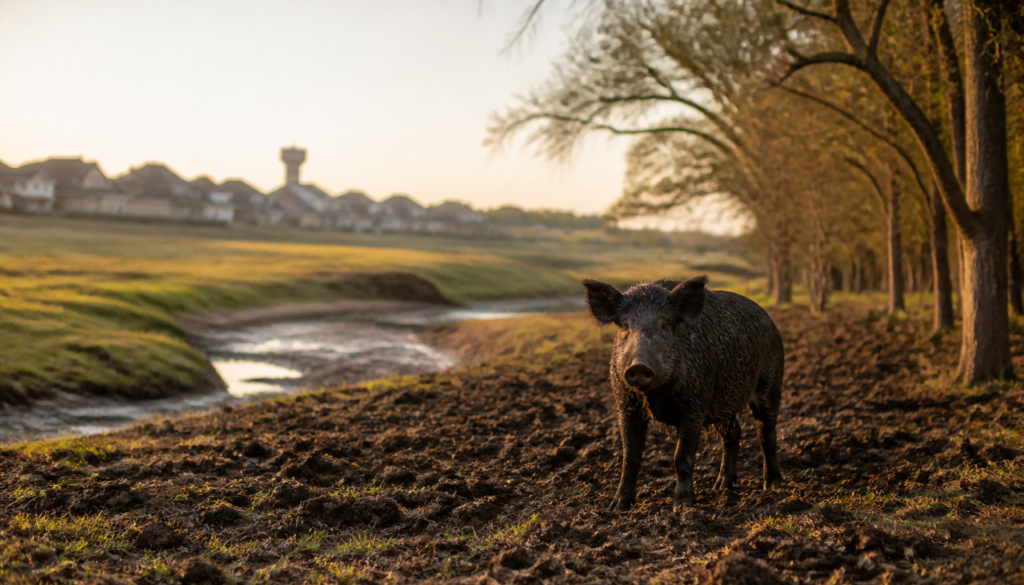
If you live in Howe or Gunter and you woke up to a rooted-up yard, a torn fence, or a sounder cutting across a farm-to-market road after dark, you are not imagining it. The hog situation in Grayson County is getting worse. The animals are not “new Texas wildlife.” They are an invasive species being squeezed by the same growth we have been mapping on U.S. 75 and SH 289.
Sherman and Van Alstyne are adding plants, rooftops, and retail. That does not erase hogs. It moves them. Creeks, greenbelts, and leftover pasture become travel corridors. The remaining rural edge—Howe, Gunter, and the acres between them—is where they land.
We already documented the Gunter side in August: Lotus Star Estates, Platinum Ranch, and the hog carcasses on Preston Road. This is the countywide follow-up. The pattern is bigger than one subdivision.
Why this is a big deal, not a rural quirk
Texas A&M’s Natural Resources Institute put the statewide herd at more than 3 million as of its April 2026 law update. USDA mapping cited in that same piece had feral pigs in 250 of 254 Texas counties as of 2024. (Do not confuse that with Sherman, Texas. The four counties listed without pigs were Panhandle and far-west counties, including Sherman County, not our city.) Crop damage alone has been estimated at more than $670 million a year, with roughly $200 million more in control and mitigation. That does not count wrecks, torn yards, or dirty water. (Texas A&M NRI; McKee et al.)
Older Texas Parks and Wildlife estimates sat around 2.6 million animals. The number you hear depends on the year and the study. The direction does not: the herd is large, it breeds young, and it does not stay on the last remaining farm.
Sows can conceive as early as six months. Gestation is about 115 days. They eat almost anything. They root at night. A Howe farmer, Scott Renfro, told KTEN in 2024 that he deals with them year-round on corn ground: they can go in overnight and tear a planted field to pieces. (KTEN)
That is the agricultural version of what Gunter homeowners are seeing in flower beds and along Preston Road.
Growth is the squeeze. Creeks are the highway.
Grayson County’s population was estimated at 153,613 as of July 1, 2025, up about 13.3% from the 2020 base. (U.S. Census Bureau) The human map is in our 10 projects piece: TI’s Sherman megasite in production, GlobalWafers next door, U.S. 75 widening through Van Alstyne and Howe, BNSF’s park in Gunter, Solara and The Landing in Van Alstyne, Platinum Ranch on the Gunter side of 289.
Every one of those projects converts pasture, brush, and creek bottoms into dirt work. Hogs do not file a complaint. They walk.
Texas Wildlife Services has been saying the same thing about the Metroplex: hogs use greenbelts and creeks as corridors between cities, then show up in watered lawns looking for grubs. (Dallas Morning News / Texas Wildlife Services) Grayson County is that story, one ring farther north. Sherman and Van Alstyne are the pressure. Howe and Gunter are the remaining cover.
Hagerman National Wildlife Refuge, on the county’s lake side, has been trapping for years because hundreds of hogs were tearing up habitat. That is not a Gunter-only problem. It is a Grayson County problem that shows up wherever there is still dirt and water. (KXII)
What we do not have—and will not invent—is an official hog census for Howe or Gunter. No city publishes a sounder count. The evidence is local and consistent: farm damage in Howe, neighborhood and roadside hogs in Gunter, and a development map that is eating the in-between.
Dumping them on the next farm is illegal
This matters more than it sounds. Texas A&M AgriLife is blunt: relocation to release is not a management option, and in Texas it is illegal. The Texas Animal Health Commission only allows live feral pigs to move from the trap site to a recognized slaughter facility, an approved holding facility, or an authorized hunting preserve—in an escape-proof trailer, for a limited time. You cannot trap a sounder in Lotus Star and turn them loose in a Howe pasture. That just moves the wreckage and can spread disease. (TAHC; Texas A&M NRI, April 2026)
On private land, with the landowner’s permission, Texas no longer requires a hunting license to hunt or trap feral pigs (that change dates to 2019). A license is still required on public land. Hunter education still applies. Night work is common; it is also the moment to stay inside city ordinances, tell a game warden what you are doing, and not shoot toward houses. (Texas A&M NRI; TPWD Outdoor Annual)
Toxicants exist on paper. They are not a backyard product. Applicators need the right Texas Department of Agriculture license. Hogs that eat warfarin bait are not table fare. If you are a homeowner with a torn St. Augustine lawn, this is not your first tool.
What actually helps in Howe and Gunter
If you are a landowner or you have permission:
- Treat it like pest control, not sport. Whole-sounder trapping (corral or cellular traps) beats shooting one animal and educating the rest.
- Coordinate with neighbors. A trap on one two-acre lot does nothing if the creek behind four houses is the highway.
- Hire a trapper if you cannot run a trap every night. Ask where captured hogs go. The legal answers are slaughter, an approved holding facility, or an authorized preserve—not “a farm down the road.”
- Fence what you can protect. A decorative yard fence will not stop a sow. Woven wire buried or tight to the ground, and gates that actually latch, matter more than height.
- Cut the buffet: pet food, fallen birdseed, easy compost, and grub-heavy lawns after rain.
If you are a commuter or you walk the dog at dusk:
- Do not approach, feed, or try to haze a hog, especially a sow with piglets.
- Keep dogs leashed near creeks and greenbelts.
- Slow down on FM 902, FM 121, Preston Road / SH 289, and the U.S. 75 frontage after dark. A 250-pound animal in the lane is a wreck, not a story.
- If a hog is in the roadway or attacking a person, call 911. Many city animal-control desks are not staffed or equipped for wildlife. That is a statewide complaint, not a Howe-specific slight.
Texas Wildlife Services and the Grayson County AgriLife office are the grown-up starting points for landowners who want a plan instead of a Facebook argument.
What this means for people moving here
If you are shopping Van Alstyne for the 75 commute, Sherman for the plant jobs, or Gunter and Howe because they still look like towns: ask about hogs the same way you ask about ISD bonds and frontage-road construction.
Walk the creek behind the model home. Ask the HOA whether trapping is allowed. Ask the seller whether the backyard has been rooted. A “country lot” on the edge of a new phase is exactly the habitat hogs use when the last pasture becomes a slab.
Growth and hogs are the same story. We are building on the land they already occupied. They will keep showing up in Howe and Gunter until the remaining cover is gone—and then they will show up in the next town that still has a creek.
Grayson County Line will keep following the ones that actually tear up yards, not the ones that only live in statewide PDFs. If you are seeing them in Howe, Gunter, or the fields between Van Alstyne and Sherman, tell us where. Named roads and dates beat rumors.