Why Grayson County Is Growing So Fast
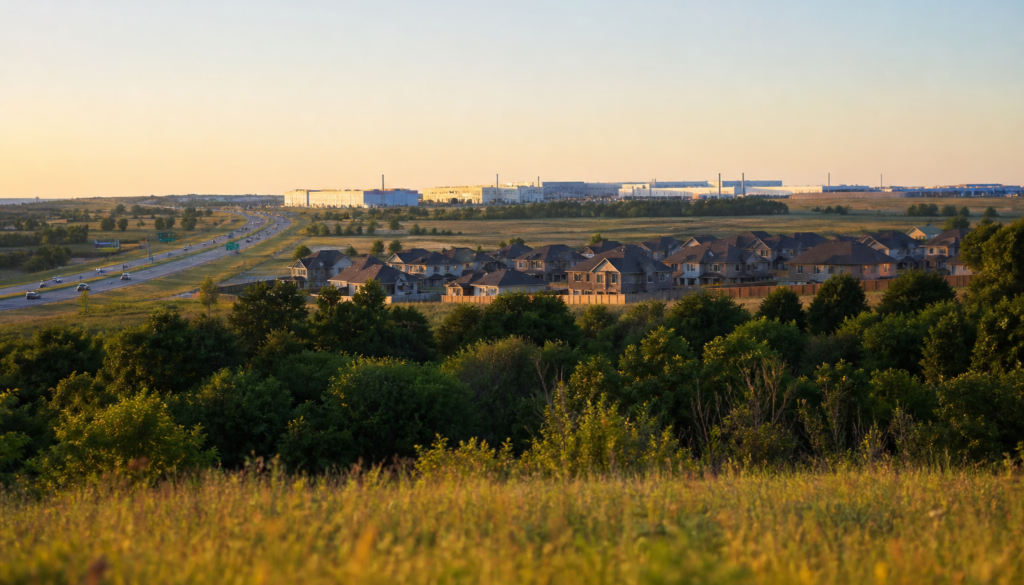
Drive U.S. 75 through Grayson County on a weekday morning and you feel it before you can name it: more trucks, more school buses, more new rooftops where pasture used to be.
The numbers back up what locals already see. The U.S. Census Bureau estimated Grayson County’s population at 153,613 as of July 1, 2025—about 13.3% above its 2020 population base. (Census.gov QuickFacts) Sherman, the county seat, grew roughly 20% between 2020 and 2025 and sat near 52,000 residents as of July 2025, according to the same Census estimates cited in recent regional reporting. (Axios Dallas, September 2026)
This isn’t random sprawl. Several forces are stacking at once—jobs, housing, highways, and the simple geography of being an hour north of Dallas–Fort Worth with room to build. Here’s a clear, newcomer-friendly look at why Grayson County is growing so fast right now.
1. Semiconductor jobs turned Sherman into a destination
The biggest shift is industrial. Texas Instruments broke ground on its Sherman megasite in 2022. In December 2025, TI announced that SM1—its first 300-millimeter wafer fab there—had started production. Company materials describe a potential multi-fab campus measured in tens of billions of dollars and thousands of direct jobs if later phases are fully built. (TI.com; Dallas Morning News)
GlobalWafers, through its Sherman subsidiary GlobiTech, opened a 300-millimeter silicon wafer plant in 2025 as well. Wafer plants feed chip plants. Together they pull suppliers, contractors, and skilled trades into the county—even when the next building is still “planned.” (Company and trade reporting)
Axios Dallas put it plainly in early September 2026: Sherman has become a semiconductor hub amid the AI boom, with Apple-linked suppliers and other chip-related employers already in the mix. (Axios Dallas)
Why it matters for families: when an employment center lands here, people stop treating Grayson County as only a cheaper bedroom for Collin County. They look for houses, daycare, restaurants, and school seats here.
2. North Texas housing demand pushed farther up U.S. 75
Even before the chip plants ramped, pandemic-era remote work and DFW housing costs nudged buyers north. Builders broke ground on thousands of new residences across Grayson County. After the semiconductor announcements, a second wave of investors chased industrial land near the plants. (Bisnow)
You see that pattern in Sherman and Denison subdivisions, and in the faster-growing towns along the corridor—Van Alstyne, Gunter, Howe—where school districts and city halls are trying to keep pace with new addresses.
For a living map of major projects, see our county development tracker and the city trackers for Sherman, Denison, Gunter, and Van Alstyne.
3. Location still does a lot of the work
Geography didn’t change, but the region around it did. Grayson County sits on the Oklahoma border with Lake Texoma to the north and the expanding Dallas–Fort Worth metro to the south. Sherman sits at the crossroads of U.S. 75 and U.S. 82—useful for freight, commuting, and weekend traffic.
TxDOT’s long-running U.S. 75 work through Sherman and Denison is meant to ease congestion and improve safety as volumes rise. That infrastructure story is unfinished (local reporting in 2026 also flagged shortfalls in county road-and-bridge funding), but the corridor itself is a big reason employers and homebuilders keep looking here. (TxDOT project materials; KTEN; KXII)
4. Water and outdoor life are part of the pitch
Growth stories often skip the boring utilities. Sherman officials have pointed to water rights tied to Lake Texoma as a practical advantage for scaling homes and industry—something Axios highlighted when comparing Sherman with other fast-growing Texas cities that face tighter water constraints. (Axios Dallas)
For newcomers, Lake Texoma and Hagerman National Wildlife Refuge are also lifestyle reasons to stay, not just visit: fishing, boating, trails, and quieter weekends without a three-hour drive.
5. Growth brings real growing pains
Fast population gains are not free. Traffic on farm-to-market roads, school capacity, and construction costs all show up in city and county meetings. Highway construction costs statewide have jumped sharply in recent years, and Grayson County leaders have pushed in Washington for a larger local share of federal transportation dollars. (KXII, May 2026)
In March 2026, KTEN reported planners saying some road improvement projects lacked available funding for the next several years—including work locals have watched along corridors such as FM 121 near Van Alstyne and FM 1417 in Sherman. That gap between demand and dollars is part of the growth story, too.
What this means if you’re moving here (or already home)
If you’re house-hunting: expect a county that still has rural edges and small-town downtowns, plus a job base that is more industrial and tech-adjacent than it was five years ago. Compare school districts, commute times, and flood/road conditions the way you would in any fast-growing North Texas market—not by brochure alone.
If you’ve been here a while: the same forces reshaping Sherman’s employment map are the ones filling classrooms in Gunter and Van Alstyne and lengthening the light at the exit ramp. Understanding the “why” doesn’t fix the traffic, but it helps you track which projects are likely to matter next.
For the project-by-project view (not just the population story), start with Grayson County Is Changing: The 10 Projects Reshaping Our Future and keep our development trackers bookmarked—we update them as timelines shift.
Sources
- U.S. Census Bureau QuickFacts, Grayson County, Texas (July 1, 2025 population estimate and percent change)
- Axios Dallas, “Tech boom is transforming Sherman” (Sept. 2, 2026)
- Texas Instruments / Dallas Morning News coverage of SM1 production start (Dec. 2025)
- Bisnow reporting on Grayson County industrial and housing investment after chip announcements
- KTEN and KXII reporting on Grayson County road/bridge funding pressure (2026)