PID Tax in Gunter TX: What New-Home Buyers Really Pay
If you buy a new home in Taylor Ranch or Platinum Ranch in Gunter, expect a PID bill of about $3,800 to $6,400 a year on top of your regular property taxes, depending on lot size. Those figures come from the cities’ bond documents, which estimate each lot’s yearly installment. In Sunset Ranch, just outside the city, the extra cost is a municipal utility district (MUD) tax of $1.00 per $100 of value. In Bryson Ranch in Pilot Point, the PID runs about $3,100 to $4,700 a year. This guide explains what those charges are, how long they last, what the law says you must be told before you sign, and how to look up the number for a specific house.
For the neighborhoods themselves (builders, prices, schools and roads), start with our guide to Gunter TX new home communities. This page sticks to the money.
What a PID is, in plain English
A public improvement district (PID) is a way to pay for a neighborhood’s streets, water and sewer lines, drainage and other public infrastructure. The developer doesn’t fold those costs into the price of the house. Instead, the city creates the district under Chapter 372 of the Texas Local Government Code, the Public Improvement District Assessment Act, sells bonds to pay for the work, and places an assessment on each lot. Homeowners repay that assessment, with interest, in yearly installments.
A few points from the statute matter most to buyers:
- It’s a lien on the lot. The assessment is a first and prior lien that runs with the land, behind only state, county, school district and city tax liens. When you sell, the remaining balance stays with the house.
- It’s collected like a tax. Installments are billed with your property taxes, and late payments draw the same kinds of penalties and interest as a late tax bill.
- You can pay it off early. The owner may prepay the assessment at any time. There’s no discount for paying a single year’s installment early.
- The plan is public. The city has to adopt a service and assessment plan (SAP), update it every year and post it on the city’s website. Those updates show the installment for each lot type.
Texas law caps PID revenue bonds at 40 years. In practice, the payment schedules in the Gunter and Pilot Point bond documents run about 30 years, through 2055 or 2056.
The real numbers, side by side
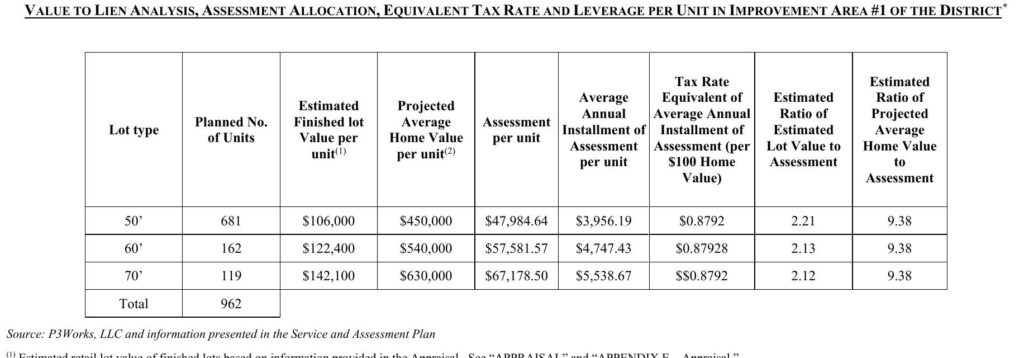
The table below uses each district’s own offering document. These are estimates prepared before the bonds were sold, and the documents label them “preliminary, subject to change.” The home values are projections supplied by the developer, not sale prices. Use the table to understand the scale of the cost, then confirm the current number for any specific lot.
| Community (district) | Lot type | Projected home value | Assessment per lot | Estimated yearly installment |
|---|---|---|---|---|
| Taylor Ranch, Gunter (PID, Improvement Area #1) | 50-foot | $475,000 | $46,265.62 | $3,792.60 |
| Taylor Ranch, Gunter | 80-foot | $675,000 | $65,745.88 | $5,389.48 |
| Taylor Ranch, Gunter | 100-foot | $800,000 | $77,921.04 | $6,387.53 |
| Platinum Ranch, Gunter (PID, Improvement Area #1) | 50-foot | $450,000 | $47,984.64 | $3,956.19 |
| Platinum Ranch, Gunter | 60-foot | $540,000 | $57,581.57 | $4,747.43 |
| Platinum Ranch, Gunter | 70-foot | $630,000 | $67,178.50 | $5,538.67 |
| Bryson Ranch, Pilot Point (PID, Improvement Area #1) | 40-foot | $384,000 | about $37,700–$38,300 | $3,126 |
| Bryson Ranch, Pilot Point | 50-foot | $480,000 | about $47,100–$47,800 | $3,907 |
| Bryson Ranch, Pilot Point | 60-foot | $576,000 | $57,404 | $4,688 |
| Sunset Ranch, unincorporated Grayson County (MUD) | All lots | n/a | No PID assessment | MUD tax of $1.00 per $100 of assessed value |
One more note on Taylor Ranch: its offering document assumed a larger bond issue than the one that actually sold. The improvement area bonds priced at $14,985,000, according to underwriter FMSbonds, so the final per-lot figures in the city’s adopted plan may differ a little from the table. Our Taylor Ranch guide covers the lots, lake and builders.
What a Gunter PID home costs in total taxes
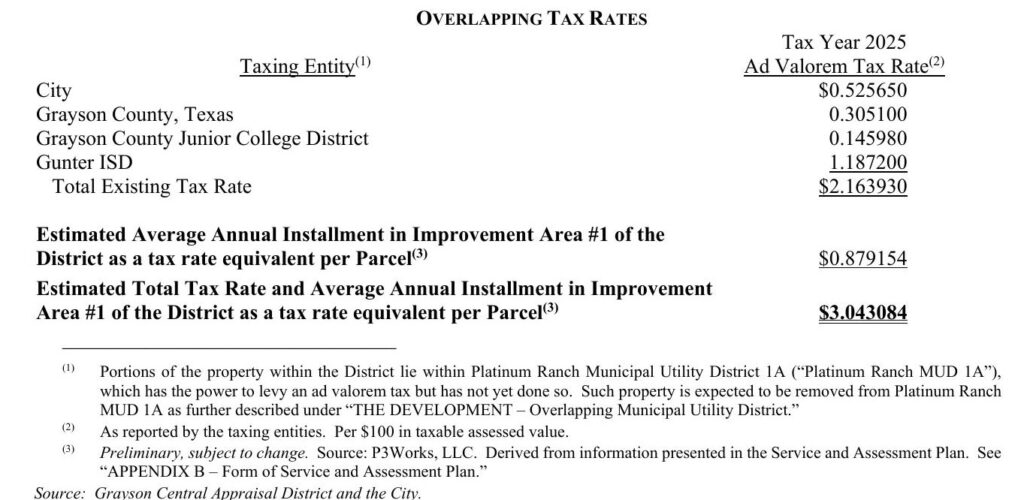
The PID installment is only part of the bill. A home inside Gunter city limits also pays the city, Grayson County, Grayson College’s junior college district and Gunter ISD. The Platinum Ranch document lists the 2025 rates:
- City of Gunter: $0.525650 per $100
- Grayson County: $0.305100
- Grayson County Junior College District: $0.145980
- Gunter ISD: $1.187200
- Total: $2.163930 per $100
The document then converts the average PID installment into an equivalent rate: about $0.88 per $100 in Platinum Ranch, which brings the all-in figure to about $3.04 per $100. Taylor Ranch works out to about $0.80, or roughly $2.96 all-in. The builder lot contracts summarized in the Platinum Ranch document say the overall equivalent rate, counting all taxing entities, should not exceed $3.09 per $100.
Here’s a worked example at the 2025 rates, before any homestead exemption, for a $450,000 home on a 50-foot Platinum Ranch lot:
- Regular property taxes: $450,000 × 2.16393% ≈ $9,738
- PID installment: $3,956 (about $330 a month in escrow)
- Total: about $13,694 a year
A homestead exemption lowers the school district portion, so an owner-occupant’s real bill will usually be lower. Tax rates are reset every year, so treat this as an illustration, not a quote.
Unlike your tax rate, the PID assessment is set by lot type in the service and assessment plan. It doesn’t climb when your home’s appraisal goes up. The yearly installment can still move a little when the city updates the plan for interest, reserves and collection costs, which is why the state notice warns that the amount may vary from year to year.
Platinum Ranch adds one more wrinkle. Part of the land sits inside Platinum Ranch Municipal Utility District 1A, which voters authorized in 2019 to issue up to $690 million in water, sewer and drainage bonds and $415 million in road bonds. According to the offering document, the MUD has issued no bonds, levies no tax, and the property is expected to be removed from it. That removal hadn’t happened when the document was written. See our Platinum Ranch Gunter guide for the full development picture.
How a MUD is different: Sunset Ranch
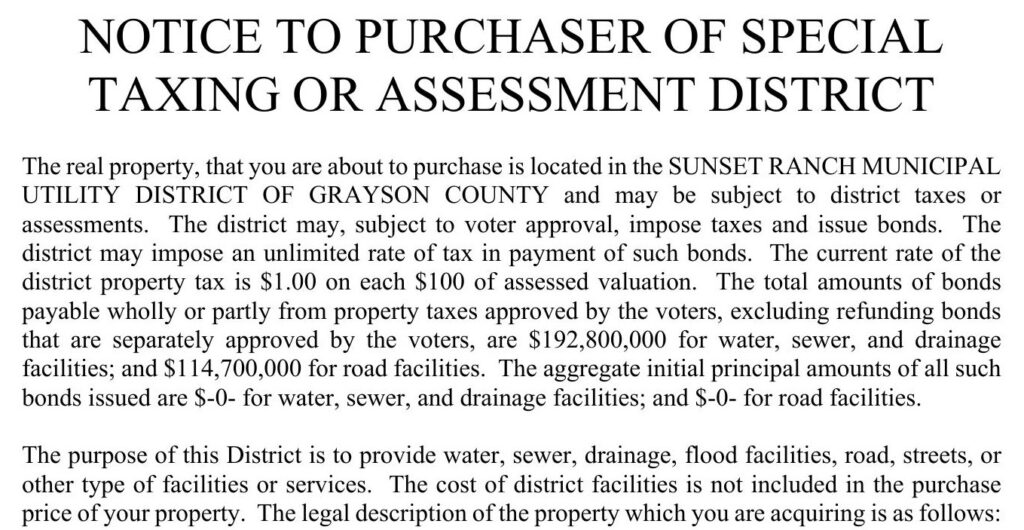
A municipal utility district (MUD) is a separate local government with its own board. Instead of a fixed assessment per lot, it levies a property tax rate on your home’s assessed value, the same way the county or school district does. Sunset Ranch Municipal Utility District of Grayson County set a $1.00 per $100 maintenance tax for the fiscal year that runs from Sept. 1, 2026, to Aug. 31, 2027. The Grayson County tax assessor-collector collects it.
For example, on a home assessed at $350,000, $1.00 per $100 comes to $3,500 a year. Because it’s a rate, the MUD bill rises when your appraisal does.
The district’s notice to purchasers carries the bigger number. Voters approved $192.8 million in bonds for water, sewer and drainage and $114.7 million for roads. As of the notice, none of those bonds had been issued. The notice also says, word for word, that “the district may impose an unlimited rate of tax in payment of such bonds” and that “the cost of district facilities is not included in the purchase price of your property.” If the district sells bonds in the future, a debt-service tax can be added on top of today’s rate.
Sunset Ranch sits in unincorporated Grayson County, so homes there don’t pay a City of Gunter tax. The MUD fills part of that role. For example, the subdivision’s plat assigns street maintenance to the district. Our Sunset Ranch Gunter TX guide covers prices, county rules and the lawsuit over street standards.
PID vs. MUD vs. HOA at a glance
| PID | MUD | HOA | |
|---|---|---|---|
| Who runs it | The city | Its own elected district board | A private homeowners association |
| How the cost is set | Fixed assessment per lot, paid in yearly installments | Tax rate per $100 of assessed value | Dues set by the association |
| Rises with your appraisal? | No | Yes | No |
| Can be paid off early? | Yes, the remaining assessment can be prepaid | No, it’s an ongoing tax | No |
| On the property tax bill? | Yes | Yes | No, billed separately |
| Ends when | The assessment is repaid (about 30 years in these districts) | No set end date | No set end date |
A PID or MUD doesn’t replace homeowners association dues. Ask for both numbers.
Pilot Point: Bryson Ranch and the other PIDs
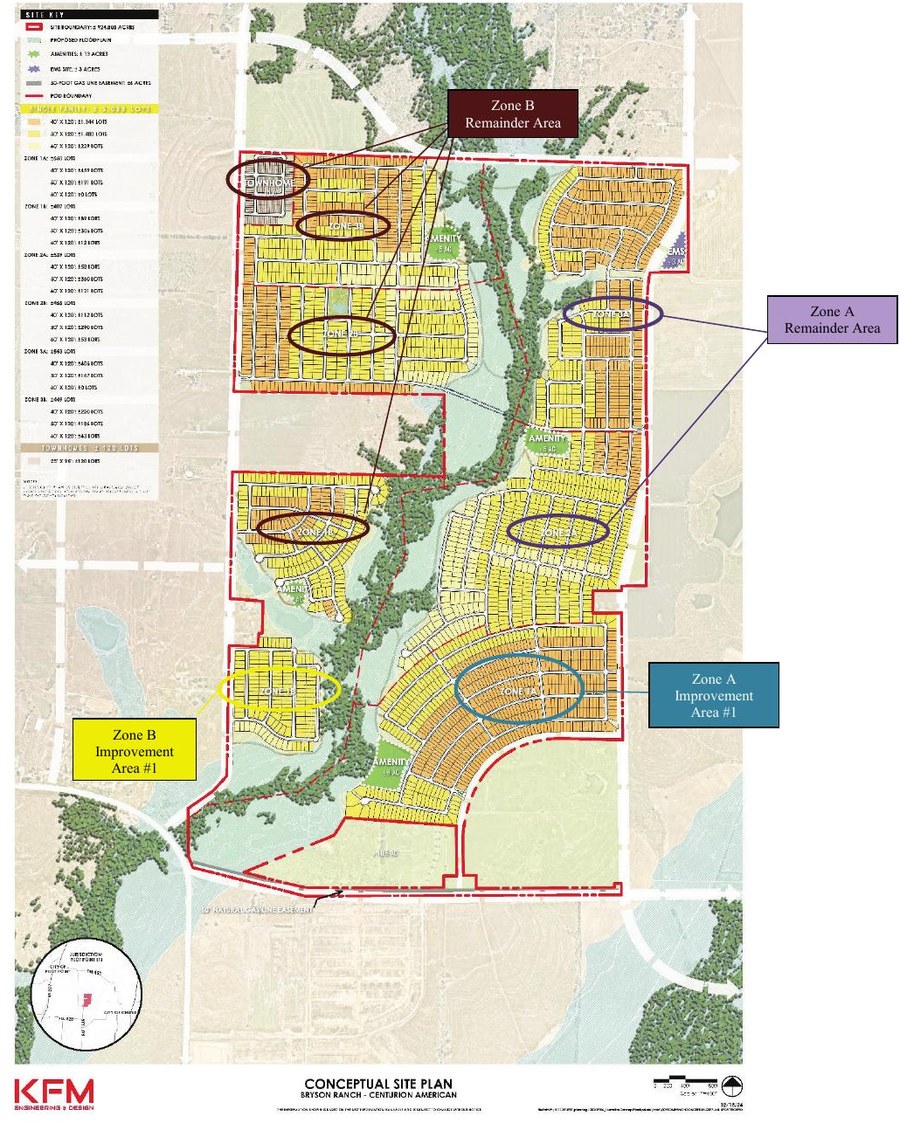
Pilot Point is in Denton County, so the base rates are different. The 2025 Bryson Ranch offering documents list 2024 rates of $0.586126 for the city, $0.187869 for Denton County and $1.026260 for Pilot Point ISD, for a total of $1.800255 per $100. The PID adds an estimated $0.8139, so the all-in equivalent is about $2.61 per $100. The city’s public improvement district page also lists plans for other new neighborhoods. Each has its own assessments, so check the plan for the specific subdivision. Our Pilot Point TX growth guide covers those neighborhoods.
The disclosures you’re owed before you sign
Texas law requires two separate notices for these districts.
- PID notice (Property Code §5.014). The seller must give you a written notice, and you must sign it, before you’re bound by the contract. It says the property is in a PID, that the assessment can be paid in installments that may change from year to year, and that unpaid assessments can bring penalties, interest, a lien and foreclosure. The city’s service and assessment plan includes a copy of the notice form.
- MUD notice (Water Code §49.452). The seller must give this notice before the contract is binding, and it’s recorded at closing. If you didn’t receive it, the law lets you terminate the contract. The notice lists the current tax rate and the bonds voters have approved.
Read the numbers in both notices, not just the signature line. The PID notice should show the assessment for your lot type, and the MUD notice shows the current rate and how much debt the district can still issue.
How to look up the number for a specific house
- Find the district. Ask the builder or listing agent which PID or MUD the lot is in and what its improvement area and lot type are.
- Get the latest service and assessment plan. The city has to post the plan and each annual update online. The update’s installment schedule shows the coming year’s amount for your lot type. For Pilot Point neighborhoods, start with the City of Pilot Point PID page.
- Check the tax account. For resale homes, the property tax statement shows the PID or MUD line from last year.
- For a MUD, check the district’s page. Sunset Ranch posts its notice and rate orders on its district page.
- Ask for the payoff amount. If you’d rather not carry the PID, ask the city’s PID administrator for the current prepayment amount for that lot.
Buyer checklist
- Get the yearly PID installment or MUD rate in writing for the exact lot.
- Ask your lender to include the PID or MUD amount in the escrow estimate.
- Add HOA dues separately.
- For a MUD, ask whether the district plans to sell bonds and what a debt tax could add.
- For a PID, ask what the remaining assessment balance is and how many years are left.
- Compare the all-in monthly cost with an older home outside a district, not just the sale price.
Frequently asked questions
Is a PID tax deductible like property tax?
The IRS treats some special assessments differently from regular property taxes. Ask a tax professional about your situation before you count on a deduction.
Does the PID go away when I sell?
No. The assessment runs with the land, so the next owner takes over the remaining installments unless the balance is paid off.
When are PID installments due?
In the Platinum Ranch offering document, installments are billed around Oct. 1 and become delinquent if unpaid before Feb. 1, the same as property taxes. The first Platinum Ranch installments are scheduled to be billed around Oct. 1, 2026.
Do older Gunter neighborhoods have a PID?
The PIDs and MUDs in this guide were created for specific new subdivisions. To check any address, look for a PID or MUD line on its property tax statement.
PIDs and MUDs aren’t good or bad on their own. They’re one way to pay for new streets and pipes, and the cost shows up in your yearly bill instead of the sale price. Compare the all-in number before you compare houses. For the communities behind these figures, see our guide to Gunter TX new home communities.