BNSF Logistics Center Gunter: Timeline, Buffers and What’s Approved
Updated November 2, 2026. The BNSF Gunter logistics center is under construction and now has its key city approvals. BNSF broke ground on March 12, 2026, and on May 21, 2026, the Gunter City Council approved the site’s revised zoning (3–2) and its preliminary plat (4–1). The development agreement puts a buffer of at least 500 feet along the site’s southern edge, the side that faces neighbors, and 800 feet for the heaviest outdoor uses. BNSF says Phase 1 will take about 19 months, so the site is likely to keep changing through 2027.
Below you’ll find where the site is, what the agreement requires for noise, light, trucks and buffers, how Gunter got here, and what’s still pending. We took the rules from the city’s own documents: the May 14, 2026 Planning and Zoning packet, which includes the full development agreement and its amendment, and the May 21, 2026 council minutes.
BNSF Gunter logistics center at a glance
- Official name: BNSF Logistics Center North Dallas
- Size: about 944 acres in total. About 515 acres sit inside Gunter city limits and the rest is in the city’s extraterritorial jurisdiction (ETJ).
- Location: east of SH 289 (Preston Road), along the BNSF tracks and north of Mackey Road
- Investment: about $500 million, as reported by KXII
- Groundbreaking: March 12, 2026
- Phase 1: about 19 months of construction (BNSF estimate). KXII reported rail operations about one year after groundbreaking.
- Jobs and impact: BNSF projects more than 6,000 jobs and over $1 billion in economic impact over time. Those are company projections, not counts.
- Latest city action: on May 21, 2026, the council approved the revised zoning (3–2) and the preliminary plat for Lots 1–5 (4–1)
Where the site is, and which neighbors are closest
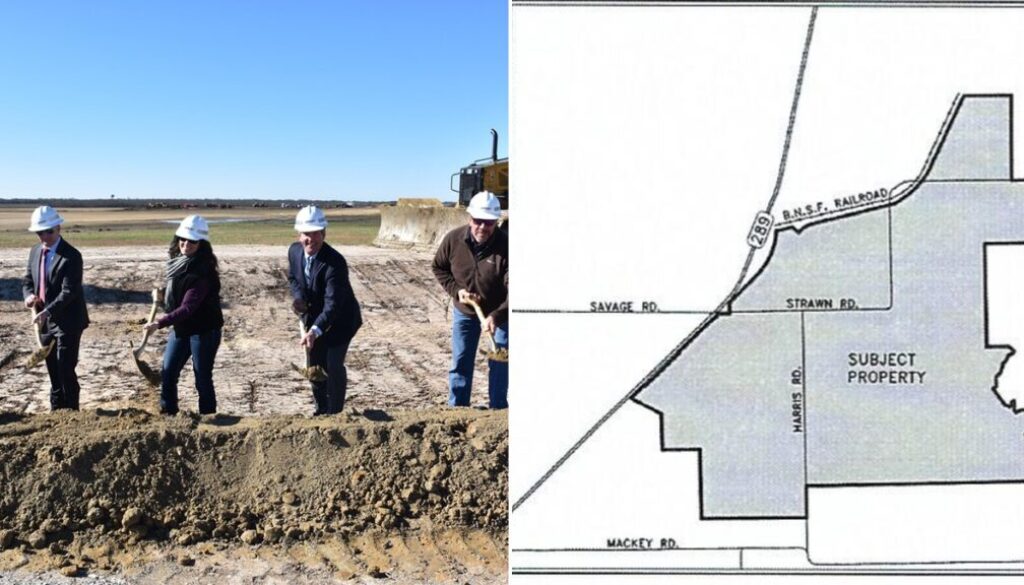
The site is a wedge of farmland on the east side of SH 289 at the BNSF line, north of Mackey Road. Strawn Road and Harris Road cross it today, and the amended agreement allows parts of both roads to be closed and abandoned as the site builds out. The north edge is railroad right-of-way, the west edge is Preston Road, and the east edge drops into the floodplain of the East Fork of the Trinity River.
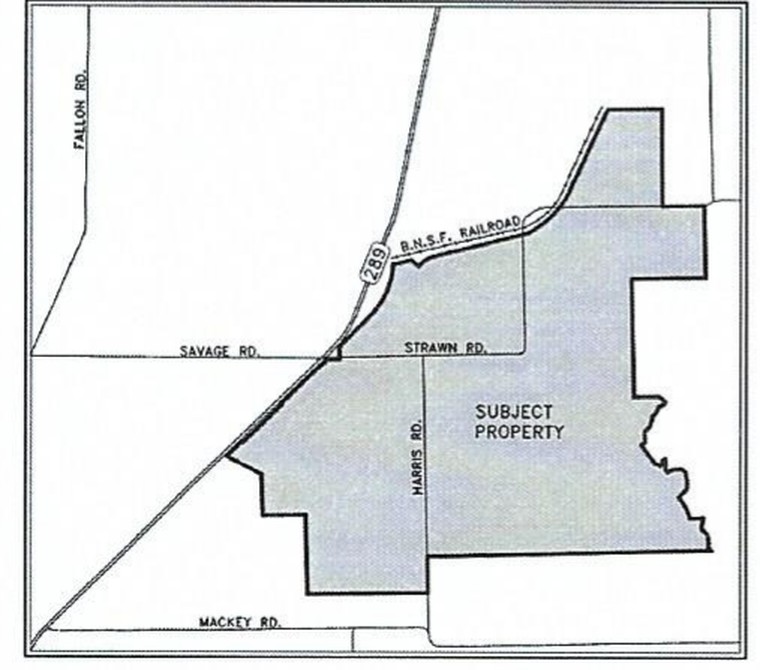
The south side is the one that faces homes, and it’s the only side where the agreement now requires a buffer. In January 2024, The Texas Tribune reported that homes in the Hidden Lakes subdivision sit about a quarter mile from the BNSF property line. Those residents live outside city limits, so they had no vote in the Gunter decisions. If you’re looking at a home or acreage near Mackey Road, Strawn Road or Harris Road, check its exact distance to the property line on the county appraisal district map before you buy.
What the agreement requires: buffers, noise, light and trucks
Most of the protections people talk about come from Exhibit H of the development agreement and from a First Amendment signed in August 2025. Here’s what the documents actually say.
| Topic | What the agreement says |
|---|---|
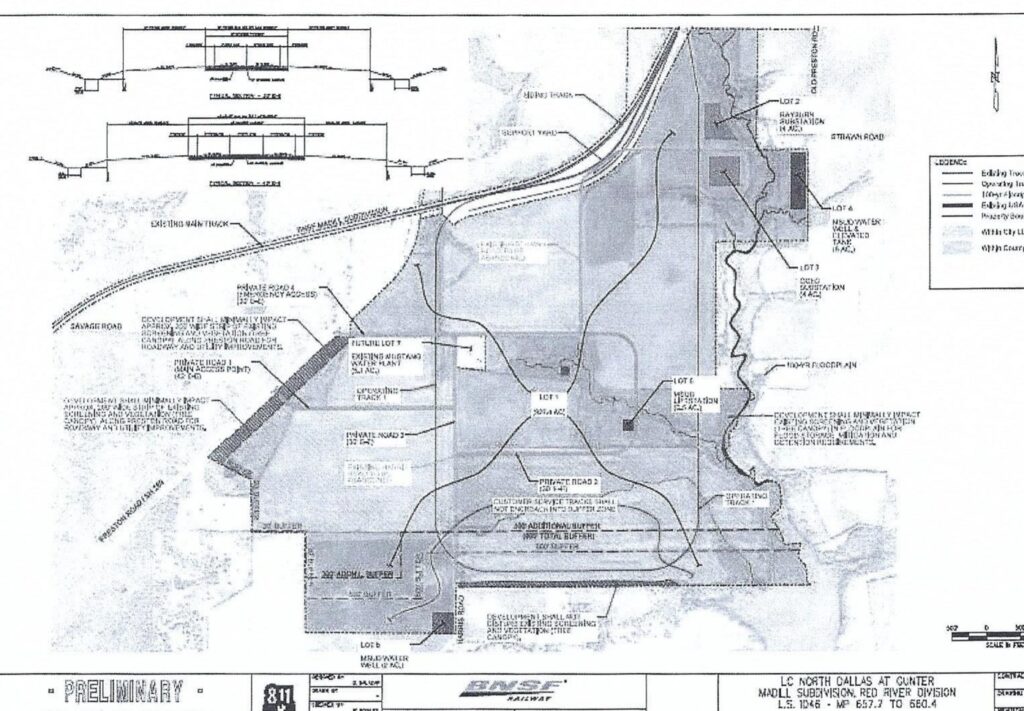
| Southern buffer | An interior buffer of at least 500 feet from the southern property line, with existing trees kept and berms, trees, shrubs and turf added |
| Heavier uses | An extra 300 feet (800 feet total) for asphalt, concrete batching, cement or lime, chemical or gas manufacturing and steel fabrication that aren’t fully enclosed |
| Screening | Where existing trees don’t screen, new trees of at least 3 caliper inches plus evergreen shrubs that reach 3 feet within 18 months |
| Other edges | No buffer required on the north (railroad), west (Preston Road right-of-way and trees) or east (floodplain). Existing native vegetation there must stay. |
| Noise | No more than 75 dB(A) at the property line, and that level for no more than 15 minutes in any hour |
| Lighting | Full cut-off fixtures, light poles no taller than 25 feet, and no direct light source visible at a residential property line |
| Height | Structures up to 55 feet. Silos, antennas or an elevated water tank up to 175 feet. |
| Hours | Operations are allowed 24 hours a day, seven days a week |
| Trucks | Tenant leases must keep commercial trucks on approved truck routes and off side and residential streets. The city wants truck traffic kept to SH 289, FM 121 and roads inside the site, and BNSF agreed to post route signs. |
| Fire response | BNSF provides yearly hazardous-materials training to Gunter’s volunteer fire department on request |
| Annexation | BNSF must petition to bring the ETJ land into the city within 36 months of the PD zoning. That land gets the same zoning once it’s annexed. |
Two points cut both ways. The original 2025 agreement called for a 500-foot buffer around the entire site, and the August 2025 amendment narrowed that to the southern edge only. Also, the allowed uses on the ETJ land include asphalt manufacturing and concrete batch plants (both barred on Lot 5), along with scrap metal storage and chemical manufacturing. That’s why the extra 300 feet matters to neighbors on the south side.
How Gunter got here: a timeline
| Date | What happened |
|---|---|
| May 2023 | The council approves a first development agreement with BNSF, effective May 18, 2023, with no public discussion |
| Oct 19, 2023 | After months of resident backlash, the city and BNSF end that agreement by mutual consent |
| Dec 2023 | All five council members resign, citing a hostile environment |
| May 2024 | The city denies BNSF’s preliminary plat (about May 10), and BNSF sues the city on May 17 in Grayson County district court |
| Jan 21, 2025 | A new development agreement is executed, meant to resolve the lawsuit |
| Aug 2025 | The First Amendment changes the buffer, setback and annexation terms |
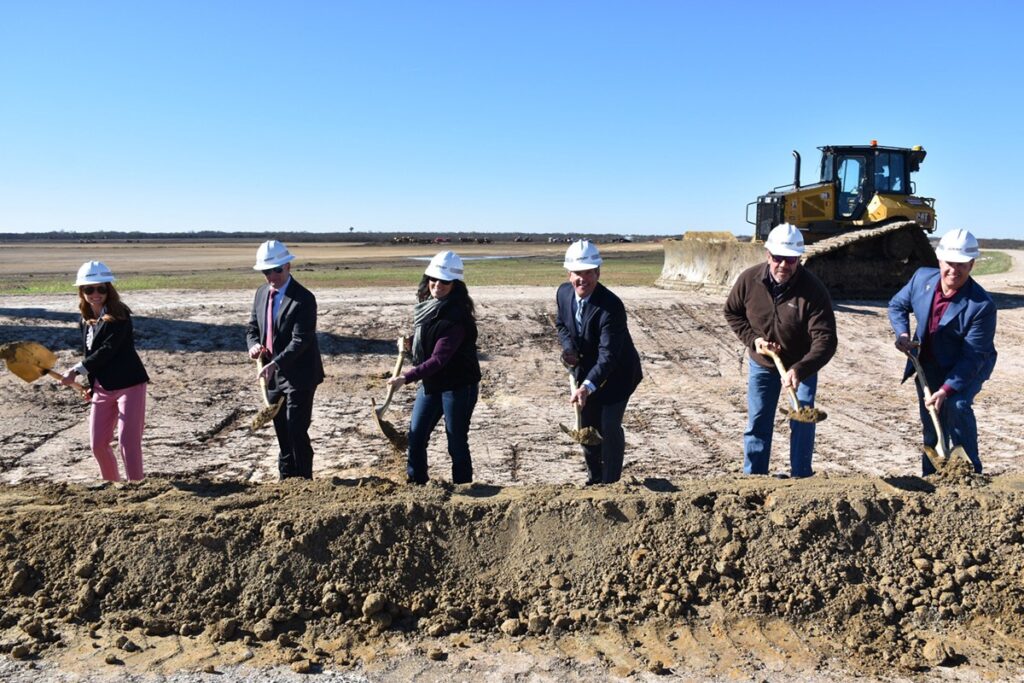
| Mar 12, 2026 | BNSF and city leaders break ground |
| May 21, 2026 | The council approves the revised PD zoning for about 515.553 acres (3–2) and the preliminary plat for about 943.935 acres (4–1) |
| About Mar 2027 | Rail operations expected, per KXII’s “about one year” report (an estimate) |
| About Oct 2027 | Phase 1 wraps up if the 19-month estimate holds (an estimate) |
In May 2026, council members Wade Burtsfield and Patrick Baumia voted against the zoning change, and Burtsfield also voted against the plat, according to the May 21, 2026 council minutes. City staff had recommended approval. Their report says the city engineer reviewed BNSF’s flood study and traffic impact study, and that the plat was first filed in November 2023 and refiled in March 2026.
Why so much of it is out of the city’s hands
Federal law covers rail operations, so the agreement says plainly that the city has no say over track design or the railroad’s operations. About 430 acres sat in the ETJ, where Gunter couldn’t apply its zoning at all. As the Tribune described in 2024, that’s why the city’s leverage was always about the land next to the rail: zoning, buffers, lighting, noise and annexation in return for city rules. BNSF keeps ownership of the site and ground-leases parcels to customers. The roads inside the site will be private, and BNSF pays for the public infrastructure it needs. Water and sewer come from other providers such as Mustang SUD, not the city.
What it means for Gunter residents
Traffic on SH 289. Trucks headed to the site will use Preston Road, the same road commuters already use. Our Gunter commute guide covers the road projects that may or may not arrive before the site is busy. The no-side-streets rule is only as good as its enforcement, and the city’s tool is the lease language plus signage.
Tax base. Once the ETJ land is annexed, it becomes taxable by the city and subject to city rules. That annexation was the main reason earlier councils wanted a deal. BNSF also pledged about $100,000 through its foundation to local groups, including the Friends of Gunter Library and Museum.
Growth pressure. The logistics center is going up while thousands of homes are planned nearby. Our guide to Gunter new home communities shows what’s planned along the SH 289 corridor. For the wider picture of what’s built, approved and still on paper, see the Gunter development tracker.
What’s still pending
- Final plat(s): the May vote approved a preliminary plat. The buffer must appear on the final plat.
- Annexation of the ETJ land: due by petition within 36 months of the PD zoning
- Tenants: none had been publicly announced in the sources we reviewed
- More city votes: the city agendas and minutes we could review from June through October 2026 showed no further BNSF vote
To follow it yourself, the city posts packets and minutes at the Gunter Agenda Center, and BNSF posts milestones in its news releases.
BNSF Gunter logistics center FAQ
Is the BNSF logistics center in Gunter still happening?
Yes. Construction began March 12, 2026, and the council approved the revised zoning and preliminary plat on May 21, 2026.
How big is the buffer from homes?
At least 500 feet along the southern property line, and 800 feet total for heavier uses that aren’t fully enclosed. The north, west and east edges have no required buffer.
Will it run at night?
It can. The agreement allows operations 24 hours a day, seven days a week, with noise capped at 75 dB(A) at the property line for no more than 15 minutes an hour, and shielded lighting.
Which roads will trucks use?
Approved truck routes only. The city’s stated preference is SH 289 (Preston Road), FM 121 (Main Street) and roads inside the site, not side or residential streets.
When will it open?
There’s no fixed opening date. BNSF estimated about 19 months for Phase 1, and KXII reported rail service roughly a year after the March 2026 groundbreaking. Treat both as estimates.
For the 2025 deal and the reaction to it, read our earlier piece, Gunter Strikes a Deal with BNSF—But at What Cost? For the growth story around it, see how fast Gunter is growing. More corridor news lives on the Grayson County Line hub.
Sources: City of Gunter Planning and Zoning packet, May 14, 2026 (staff report, development agreement, First Amendment, Exhibit H); Gunter City Council minutes, May 21, 2026; BNSF Railway groundbreaking release, March 12, 2026; KXII, March 12, 2026; The Texas Tribune, January 18, 2024.